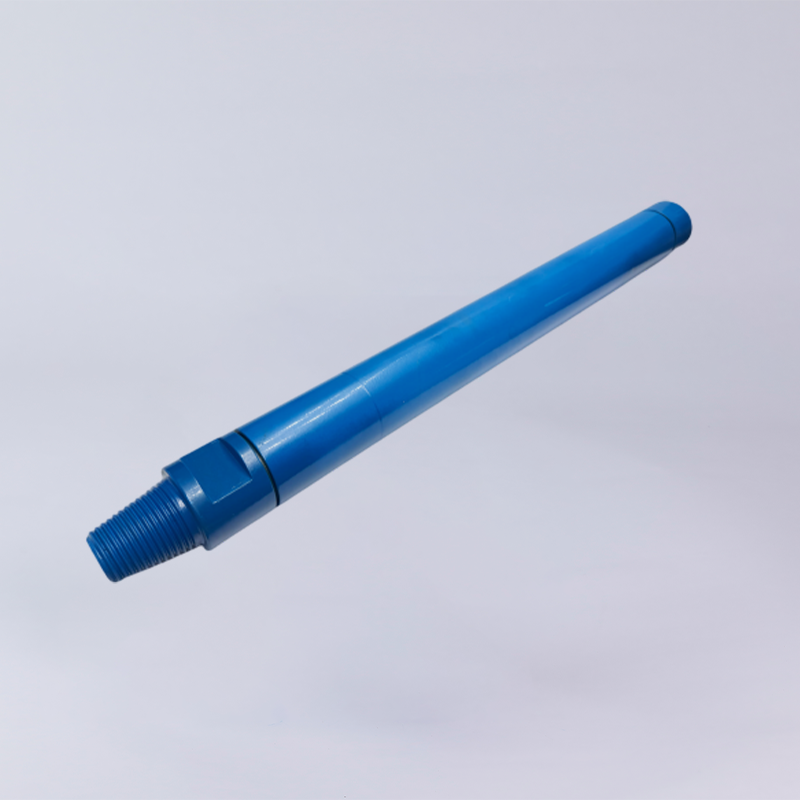
Introduction
Large-diameter Down-the-Hole (DTH) hammer drilling is a high-efficiency rock drilling method that combines percussive impact and rotary drilling to break hard rock formations. It is widely used in tunneling, underground space development, mining, and foundation engineering projects where large boreholes and stable drilling performance are required.
Compared with conventional drilling methods, DTH hammer drilling delivers impact energy directly at the bottom of the hole, significantly improving penetration efficiency and hole straightness, especially in hard and complex geological conditions.
Why Complex Formations Are a Major Challenge in Drilling Engineering
In tunnel construction and underground space development, drilling operations often encounter special and complex geological formations, such as hard rock, gravel layers, fractured zones, and mixed strata. These conditions create significant technical difficulties for conventional drilling methods.
Traditional drilling techniques—such as mud-supported rotary drilling or standard roller cone bit drilling—often fail to meet engineering requirements in such environments. For example:
- In gravel and cobble formations, mud rotary drilling may cause ground settlement or instability, increasing construction risks.
- In hard rock or fractured formations, conventional drill bits are prone to severe wear, blockage, and low penetration rates, which significantly delays construction progress and increases operational costs.
- In mixed and highly variable strata, maintaining borehole stability and alignment becomes extremely difficult, often resulting in hole deviation or collapse.
As underground engineering projects continue to expand toward deeper levels and more complex geological environments, the limitations of traditional drilling methods have become increasingly apparent. There is a growing demand for a drilling technology that is both highly efficient and adaptable to variable ground conditions.
Why Large-Diameter DTH Hammer Technology Becomes the Preferred Solution
In recent years, large-diameter DTH hammer drilling technology has emerged as one of the most effective solutions for complex formation drilling due to its high-impact energy output and strong adaptability.
Research and field applications have shown that by optimizing DTH hammer structures—such as adding guide stabilization devices, centralized bit designs, and improved energy transmission systems—it is possible to significantly enhance both drilling stability and rock-breaking efficiency in complex geological conditions.
As a result, DTH hammers are increasingly becoming the core technology for large-diameter borehole construction in hard rock, fractured formations, and other challenging ground environments.
Characteristics of Special and Complex Formations
In drilling engineering, special and complex formations present significant challenges due to their highly variable mechanical properties, poor stability, and unpredictable behavior during borehole creation. These geological conditions are among the most difficult environments for large-diameter DTH hammer drilling operations.
Hard Rock Formations
Hard rock formations are characterized by high compressive strength and extreme hardness, which significantly increases drilling resistance.
In such conditions:
- Penetration rates are typically low
- Drill bits are subjected to severe impact and abrasive wear
- Energy consumption increases significantly
- Conventional drilling methods often fail to achieve efficient rock breaking
As a result, hard rock drilling requires high-impact energy systems and wear-resistant drilling tools to maintain productivity.
Cobble and Gravel Formations
Cobble and gravel formations consist of loosely distributed, irregularly shaped particles with varying sizes and random orientation, making the formation highly unstable during drilling.
Typical drilling challenges include:
- Bit jamming or blockage (bit trapping in large particles)
- Circulation loss or poor flushing efficiency
- Borehole instability due to particle movement
- Reduced drilling accuracy and efficiency
These formations require strong impact capability and efficient cuttings removal to maintain continuous drilling progress.
Karst and Cavernous Formations
Karst formations contain voids, cavities, and underground channels of varying sizes and shapes. These cavities may be filled with water, clay, or loose sediments, making drilling operations highly unpredictable.
Key risks include:
- Borehole collapse due to sudden void exposure
- Tool drop or loss into cavities
- Fluid loss and unstable borehole pressure conditions
- Difficulty in maintaining borehole integrity
Effective drilling in such formations requires advanced stabilization strategies and adaptive drilling systems.
Other Complex Geological Conditions
In addition to the above, several other challenging formations are commonly encountered in underground engineering, including:
- Fractured rock formations – characterized by weak structural integrity and discontinuities
- Mudstone formations – prone to softening, sticking, and borehole shrinkage
- Sandy or flowing sand layers – highly unstable and susceptible to collapse and fluid loss
Each of these formations presents unique drilling difficulties, often requiring customized drilling parameters, specialized tools, and optimized energy transmission systems to ensure safe and efficient operation.
Working Principle and Advantages of Large-Diameter DTH Hammer Drilling Technology
Large-diameter Down-the-Hole (DTH) hammer drilling is a highly efficient rock excavation method that integrates impact energy and rotary motion to achieve rapid penetration in hard and complex geological formations. Its performance is determined by the coordinated operation of the drilling system, which consists of multiple key components working together as a unified system.
Equipment Composition
Drilling Rig
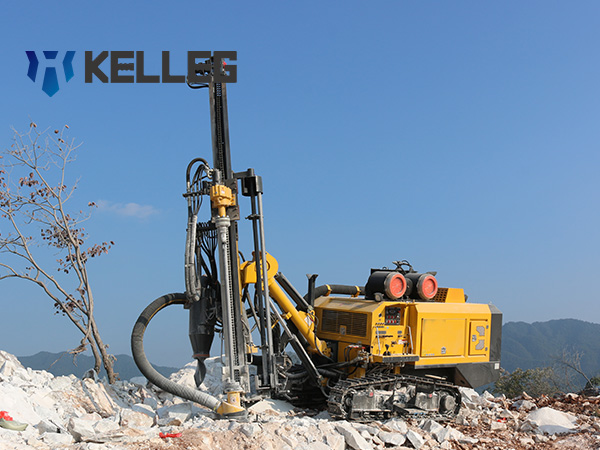
The drilling rig serves as the primary power and control unit of the entire system. Its performance directly determines drilling efficiency and operational stability.
For large-diameter DTH drilling applications, the rig must provide:
- High rotary torque for rock breaking resistance
- Sufficient hoisting capacity for deep hole operations
- Stable feed pressure to maintain consistent penetration
A properly configured rig ensures smooth energy transfer and operational reliability under complex geological conditions.
DTH Hammer
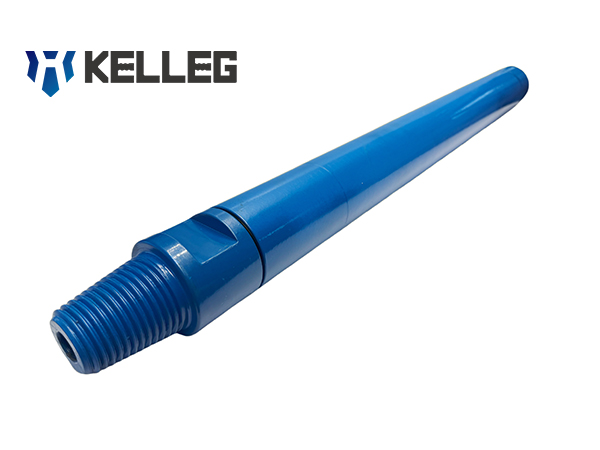
The DTH hammer is the core impact component of the system. It converts compressed air energy into high-frequency mechanical impact directly at the bottom of the borehole.
Key performance requirements include:
- High impact energy output
- Stable impact frequency
- Strong adaptability to variable formations
Its efficiency directly determines penetration rate and rock fragmentation performance.
Air Compressor
The air compressor provides the necessary compressed air power for hammer operation and cuttings removal.
Its performance should ensure:
- Adequate air volume (flow rate)
- Stable working pressure
- Continuous energy supply for deep-hole drilling
Insufficient air supply can significantly reduce hammer efficiency and drilling stability.
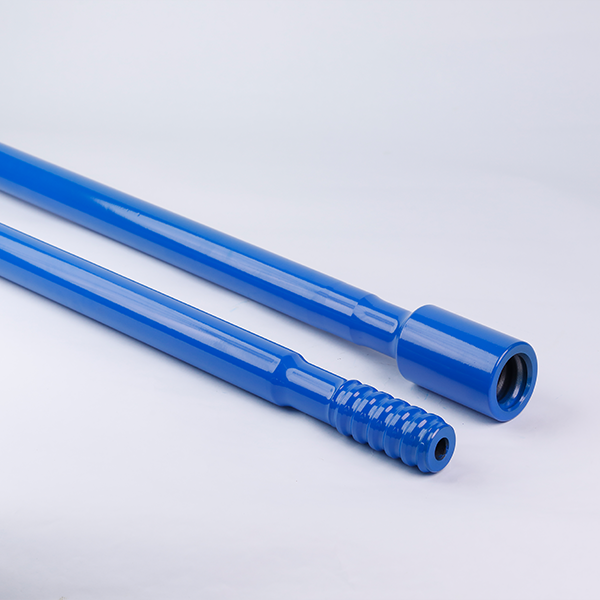
Drill Pipes
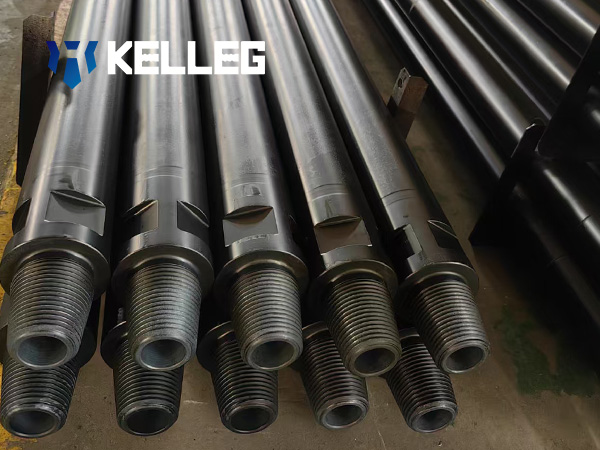
Drill pipes connect the surface drilling rig with the down-the-hole hammer, transmitting torque, rotation, and auxiliary energy.
They must feature:
- High torsional strength
- Excellent fatigue resistance
- Structural rigidity for deep drilling stability
Reliable drill pipe performance is essential for maintaining hole straightness and drilling safety.
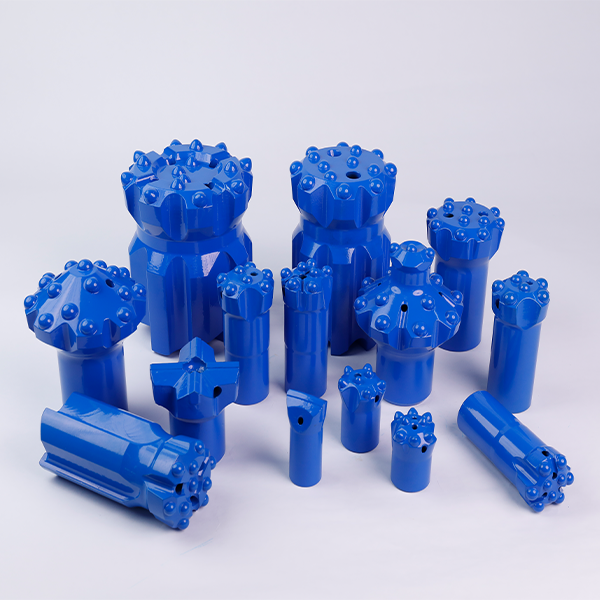
Drill Bits
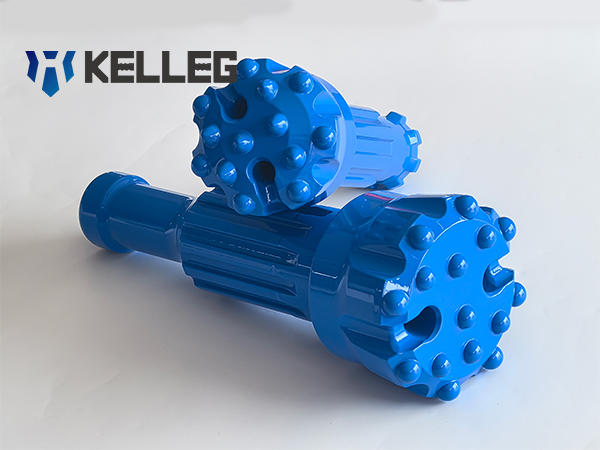
The drill bit is the direct rock-breaking tool in contact with the formation. Its design and material selection must be adapted to geological conditions.
Common considerations include:
- Button shape and layout design
- Carbide grade selection (wear resistance)
- Gauge protection structure for hole diameter control
Auxiliary Equipments
Supporting equipment plays an important role in improving operational efficiency and environmental control, including:
- Dust collections for environmental protection
- Slurry or flushing holes for cuttings removal
- Measurement and monitoring instruments for drilling accuracy control
Working Principle
Large-diameter DTH hammer drilling operates based on compressed air-driven impact rock breaking technology.
The working process can be summarized as follows:
Compressed air is supplied through the drill pipe to the DTH hammer, where it drives the piston to generate high-frequency impacts directly on the drill bit. These repeated impacts crush the rock at the bottom of the borehole into fragments. Simultaneously, the compressed air carries the cuttings upward and removes them from the hole, ensuring continuous and efficient drilling.
Unlike surface-impact drilling methods, DTH drilling delivers energy directly at the rock interface, minimizing energy loss along the drill pipe and significantly improving rock-breaking efficiency—especially in hard rock and complex formations.
For large-diameter applications, this method enables stable formation of wide boreholes while maintaining high penetration efficiency and operational reliability.
Technical Advantages
High Drilling Efficiency
Large-diameter DTH hammer drilling achieves rapid rock fragmentation through high-frequency impact energy, significantly increasing penetration rates compared with conventional drilling methods.
Excellent Borehole Quality
The drilling process ensures:
- High borehole straightness
- Smooth and stable borehole walls
- Reduced deviation in deep drilling operations
This makes it suitable for precision engineering applications such as tunneling and foundation drilling.
Wide Geological Adaptability
DTH hammer drilling performs effectively across a broad range of formations, including:
- Hard rock
- Cobble and gravel layers
- Fractured and karst formations
Its strong adaptability makes it a preferred solution for complex underground conditions.
Reduced Overall Construction Cost
Due to its high penetration efficiency and reduced tool failure rate, DTH hammer drilling significantly shortens project duration and lowers:
- Drilling time cost
- Tool replacement frequency
- Operational downtime
As a result, it provides a cost-effective solution for large-scale engineering projects.
Key Technologies & Engineering Solution
In large-diameter DTH hammer drilling for complex geological formations, successful performance depends on the integration of multiple engineering technologies rather than a single component. The following section summarizes the core technologies and their corresponding engineering challenges and solutions.
Key Technologies
High-Energy Impact Optimization Technology
Enhances rock-breaking efficiency by improving hammer impact frequency and energy transmission directly at the borehole bottom.
Adaptive Bit Design Technology for Complex Formations
Optimized button layouts, carbide grades, and face geometry improve performance in hard rock, fractured zones, and mixed strata.
High-Efficiency Airflow and Cuttings Removal Hole
Ensures stable bottom-hole cleaning through high-pressure compressed air circulation, reducing drilling blockage and improving penetration rate.
Borehole Stability Control Technology
Includes stabilizers, casing systems, and optimized drilling parameters to maintain hole integrity in unstable formations.
Energy Transmission Efficiency Technology
Reduces energy loss across the drill pipe by improving rod connections, joint rigidity, and system alignment.
Wear-Resistant Material Technology
Uses high-grade carbide inserts and heat-treated steel bodies to extend tool life under extreme drilling conditions.
Engineering Problems vs Technical Solutions
| Engineering Challenge | Typical Cause | Key Technology Solution |
|---|---|---|
| Low penetration rate in hard rock | High rock compressive strength | High-energy impact optimization + advanced DTH hammer design |
| Bit wear and frequent failure | Abrasive formation conditions | Wear-resistant carbide bit + optimized button structure |
| Hole collapse in fractured or loose formations | Poor formation stability | Borehole stability control + casing systems |
| Drill pipe vibration and deviation | Uneven energy transmission | Energy transmission optimization + stabilizer tools |
| Poor cuttings removal | Insufficient air circulation | High-efficiency airflow system |
| Reduced drilling efficiency in mixed formations | Variable rock hardness | Adaptive bit design + adjustable drilling parameters |
Performance Comparison of Large-Diameter DTH Hammer Under Different Working Conditions
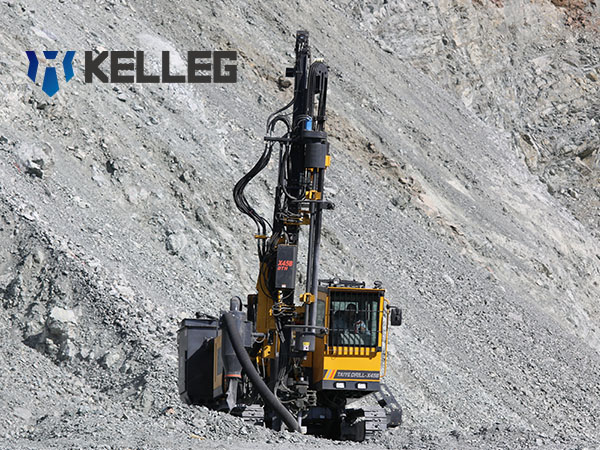
To systematically evaluate the overall performance of large-diameter Down-the-Hole (DTH) hammer drilling technology, this section compares typical complex geological formations—including hard rock, cobble/gravel layers, karst cavities, and fractured formations—under different operational parameters such as impact frequency, air pressure, and drill bit configuration.
By integrating field engineering data and published research cases, the analysis highlights both the adaptability of DTH drilling and the key directions for performance optimization.
Formation Adaptability Comparison
Hard Rock Formations
In hard rock conditions, DTH hammer drilling demonstrates significantly higher rock-breaking efficiency compared with conventional roller cone drilling, with penetration performance improving by approximately 2–3 times.
However, the extreme hardness and abrasiveness of the rock lead to accelerated bit wear. Therefore, reinforced tungsten carbide bit designs and high-strength alloy materials are required to ensure operational stability and extended service life.
Cobble and Gravel Formations
In cobble and gravel layers, drilling efficiency benefits from air-lift reverse circulation (air flush) cuttings removal technology, which improves penetration rates to approximately 1.5–2.0 m/h.
Compared with traditional wet rotary drilling methods, DTH drilling also delivers better borehole verticality and reduced risk of formation disturbance.
Karst and Cavernous Formations
In karst environments, the application of steel casing support systems is often required to maintain borehole stability.
Although additional energy consumption may increase by approximately 20%, this method effectively prevents borehole collapse and tool loss, which are common risks in conventional rotary drilling systems.
Fractured Formations
In fractured rock conditions, optimizing impact frequency to approximately 18–22 Hz helps reduce energy loss caused by discontinuous rock structures.
Under optimized parameters, drilling efficiency can be improved by 15%–20% compared with non-optimized impact modes, particularly in highly fractured geological zones.
Drilling Parameter Optimization Comparison
Impact Frequency vs Geological Conditions
- High-frequency impact systems are most suitable for hard rock formations, where high compressive strength requires stronger and more frequent impact energy. However, they must be combined with high air pressure systems to ensure efficient cuttings removal.
- Medium-frequency impact modes provide a balanced performance in cobble and gravel formations, optimizing both rock-breaking efficiency and debris discharge. This configuration typically results in the lowest overall operational cost.
Energy Consumption vs Construction Cost
High-frequency impact drilling systems generally result in a 25%–30% increase in energy consumption, but they significantly improve borehole accuracy, with diameter deviation controlled within ≤2%. This makes them particularly suitable for precision-demanding projects such as subway pipe roof construction.
In contrast, low-frequency impact modes used in karst formations often require additional stabilization measures such as casing advancement systems, which increases overall construction costs despite lower energy input.
Key Insight
From a comprehensive engineering perspective, the performance of large-diameter DTH hammer drilling is highly dependent on the interaction between:
- Geological formation characteristics
- Impact frequency and energy output
- Air pressure and flushing efficiency
- Tool selection and system configuration
Optimized matching of these parameters is essential to achieving the best balance between penetration efficiency, borehole stability, and overall construction cost.
Construction Technology and Applications of Large-Diameter DTH Hammer Drilling
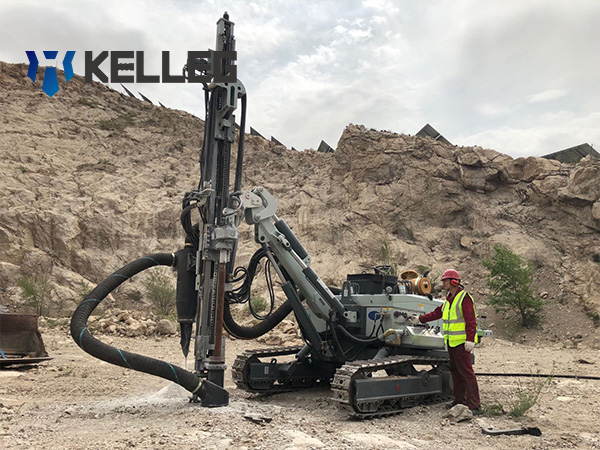
Large-diameter Down-the-Hole (DTH) hammer drilling technology is widely applied in foundation engineering, tunneling, mining, and underground construction due to its high efficiency, strong adaptability, and excellent performance in complex geological conditions.
Construction Technology Workflow
Construction Preparation
Before drilling begins, systematic preparation is required to ensure safety, accuracy, and efficiency:
- Review construction drawings and geological investigation reports to understand lithology, mechanical properties, and project requirements
- Select appropriate drilling rigs, DTH hammers, drill bits, and auxiliary tools, and perform inspection and commissioning
- Prepare and level the construction site, including access roads and working platforms
- Develop a detailed construction plan, safety protocol, and technical briefing for operators
Proper preparation is essential for minimizing operational risks in complex formations.
Borehole Positioning
Borehole positioning is carried out based on the design coordinates provided by the project owner.
- Use total station surveying equipment for accurate positioning
- Coordinate input must be double-checked by two operators to avoid errors
- Layout is carried out using polar coordinate methods according to pile layout drawings
- Positions are adjusted progressively as construction advances
High-precision positioning ensures structural accuracy in foundation works.
Drilling Rig Positioning
- Move the drilling rig to the designated drilling point
- Align the drilling tool center with the designed borehole center
- All rig movements must be directed by the site supervisor
- Ensure stable ground conditions before positioning
- Adjust rig verticality and leveling to guarantee drilling stability
Accurate rig alignment is critical for maintaining borehole straightness.
Drilling Operation
- Start the air compressor to supply high-pressure air to the DTH hammer
- Activate the drilling system and begin penetration
- Adjust drilling parameters according to formation conditions, including:
- Penetration rate
- Impact frequency
- Air pressure
- Continuously discharge cuttings to maintain borehole cleanliness
- Monitor drilling conditions in real time; stop operation immediately if abnormalities occur
Adaptive parameter control is essential in variable geological environments.
Borehole Inspection and Acceptance
After reaching the designed depth:
- Measure borehole depth
- Inspect borehole diameter consistency
- Check verticality and alignment accuracy
- Confirm compliance with engineering design standards
Only qualified boreholes proceed to the next construction stage.
Engineering Applications of Large-Diameter DTH Hammer Technology
Bored Pile Construction in Complex Formations
Large-diameter DTH hammers are widely used in bored pile foundation engineering, especially in:
- Sand layers and silty soil
- Cobble and gravel formations
- Flowing sand and underground water zones
- Hard rock and weathered rock layers
- Karst and cavernous formations
By combining casing advancement technology with DTH drilling, the system can penetrate unstable formations and reach stable bearing strata, ensuring high-quality pile formation and improved structural integrity.
Drilling in Underground Obstruction Conditions
Equipped with dual-power rotary drilling systems, DTH rigs can generate high torque and strong drilling force, enabling efficient penetration in:
- Boulder and gravel layers
- Inclined bedrock formations
- Abandoned pile foundations
- Underground concrete or structural remnants
The system offers high rigidity and adaptability, making it suitable for complex urban underground reconstruction projects.
Under-Reamed Pile Construction
When combined with under-reaming DTH drilling tools, the technology enables efficient expansion at pile bases.
Key advantages include:
- Strong penetration capability through mixed and hard formations
- Efficient expansion in medium and slightly weathered rock layers
- Improved load-bearing capacity of foundation piles
- Higher construction efficiency compared with conventional methods
This makes it suitable for high-load infrastructure projects such as bridges and high-rise foundations.
Karst and Cavernous Formation Drilling
In karst and cavity-rich formations, DTH drilling can be integrated with:
- Steel casing systems
- Pre-stressed pipe pile systems
- Casing-while-drilling techniques
These methods enable:
- Vibration-free construction
- Effective collapse prevention
- Stable drilling in voided formations
- High efficiency in complex subsurface conditions
This technology is widely used in hydropower, tunnels, and deep foundation engineering.
Common Problems and Solutions in Large-Diameter DTH Hammer Drilling
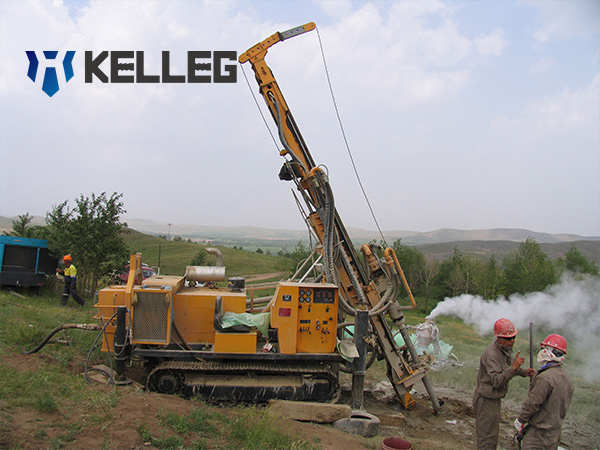
Although large-diameter Down-the-Hole (DTH) hammer drilling technology offers high efficiency and strong adaptability in complex formations, practical construction still faces several operational risks. These issues are mainly related to formation variability, drilling parameter control, and equipment wear. The following section summarizes typical problems and corresponding engineering solutions.
Bit or Hammer Sticking (Stuck Pipe / Bit Jamming)
Causes:
- Highly heterogeneous formations with uneven rock hardness, leading to unstable drilling resistance
- Cobble or boulder formations causing mechanical blockage of the hammer or bit
- Improper drilling parameters, such as excessive penetration rate or overly high impact frequency
Solutions:
- Optimize drilling parameters by reducing penetration rate and adjusting impact frequency
- Perform controlled lifting and reciprocating movements of the drill string to release stuck tools
- In severe cases, apply reverse circulation, vibration assistance, or controlled recovery techniques
Mud Loss (Circulation Loss / Fluid Leakage)
Causes:
- Highly fractured formations with developed fissures and void channels
- Unstable borehole walls leading to continuous fluid loss
Solutions:
- Adjust drilling fluid properties by increasing viscosity and density to improve sealing capacity
- Use sealing materials such as cement, clay, or chemical grouting agents to block fractures
- Enhance borehole stability through casing installation or reinforcement methods such as anchoring systems
Borehole Collapse
Causes:
- Loose or unconsolidated formations with insufficient self-supporting strength
- Poor drilling fluid performance leading to inadequate wall support
- Excessive mechanical disturbance during drilling operations
Solutions:
- Optimize drilling parameters to minimize borehole disturbance
- Strengthen mud management to ensure stable rheological performance
- Apply timely borehole support measures such as casing pipes or rock bolts
- In severe collapse cases, perform re-drilling or controlled concrete backfilling stabilization
DTH Hammer Wear and Failure
Causes:
- Long-term operation leading to natural wear of internal components
- High-strength hard rock formations causing excessive impact loads
- Improper operational parameters such as excessive impact frequency or air pressure
Solutions:
- Implement regular inspection, maintenance, and replacement of worn components
- Select appropriate hammer models based on formation hardness and drilling conditions
- Strictly control operational parameters in accordance with recommended technical specifications
- Optimize air pressure and impact frequency to avoid overload conditions
Key Engineering Insight
The majority of failures in large-diameter DTH hammer drilling are not caused by a single factor, but by the interaction of:
- Geological complexity
- Improper drilling parameter control
- Insufficient borehole stability management
- Equipment mismatch with formation conditions
Therefore, a systematic drilling strategy combining formation analysis, parameter optimization, and real-time operational control is essential for safe and efficient construction.
Development Trends of Large-Diameter DTH Hammer Drilling Technology
With the continuous advancement of underground engineering, mining, and infrastructure construction, large-diameter Down-the-Hole (DTH) hammer drilling technology is evolving toward higher efficiency, greater intelligence, and improved environmental performance. Future development will be driven by both technological innovation and expanding application demands.
Intelligent and Automated Drilling Systems
One of the most significant trends is the transition toward intelligent drilling systems.
Future DTH drilling equipment will increasingly integrate:
- Automated drilling parameter control systems
- Real-time formation monitoring sensors
- Remote operation and digital control platforms
These technologies will enable operators to:
- Automatically adjust impact frequency, air pressure, and penetration rate
- Monitor borehole conditions in real time
- Reduce human intervention and operational errors
As a result, overall drilling efficiency, safety, and consistency will be significantly improved.
Continuous Technological Innovation
Ongoing innovation in core drilling components and system integration will remain a key development direction.
Future advancements are expected in:
- High-performance DTH hammer structures with improved energy efficiency
- Enhanced drill bit materials with higher wear resistance and longer service life
- Optimized energy transmission systems to reduce power loss
- Improved compatibility between drilling rigs, hammers, and air systems
These innovations will directly contribute to higher penetration rates, improved borehole quality, and reduced operational costs.
Expansion of Application Fields
The application scope of large-diameter DTH hammer drilling technology is expected to continue expanding beyond traditional mining and foundation engineering.
Emerging application areas include:
- Underground urban space development
- Deep foundation engineering for high-rise infrastructure
- Hydropower and water conservancy projects
- Offshore and marine foundation construction
- Large-scale tunnel and transportation infrastructure projects
As geological conditions become more complex, the demand for high-adaptability drilling technologies will continue to increase.
Green and Energy-Efficient Drilling Technology
Environmental sustainability is becoming an increasingly important focus in drilling engineering.
Future development will emphasize:
- Reduction of energy consumption during drilling operations
- Optimization of compressed air utilization efficiency
- Development of low-emission and environmentally friendly drilling systems
- Minimization of noise, dust, and ground disturbance
Green drilling technologies will not only reduce environmental impact but also improve overall project sustainability and regulatory compliance.
Conclusion
Large-diameter Down-the-Hole (DTH) hammer drilling technology has proven to be a highly efficient and adaptable solution for construction in complex and special geological formations. Compared with conventional drilling methods, it offers significant advantages in penetration efficiency, borehole stability, and overall construction reliability, particularly in hard rock, fractured zones, cobble layers, and karst environments.
The performance of this technology is not determined by a single factor, but by the coordinated optimization of multiple key elements, including drilling system configuration, impact energy control, air flushing efficiency, and formation-adaptive tool selection. When these parameters are properly matched to geological conditions, large-diameter DTH systems can achieve stable, high-efficiency, and cost-effective drilling performance.
In addition, continuous improvements in equipment design, material technology, and drilling parameter optimization have further expanded the applicability of DTH hammer systems in increasingly complex engineering environments. Emerging trends such as intelligent control, automation, and green drilling will further enhance its role in future underground and infrastructure development.
Overall, large-diameter DTH hammer drilling technology is evolving into a core enabling method for modern geotechnical and underground engineering, providing reliable technical support for safe, efficient, and sustainable construction in challenging ground conditions.